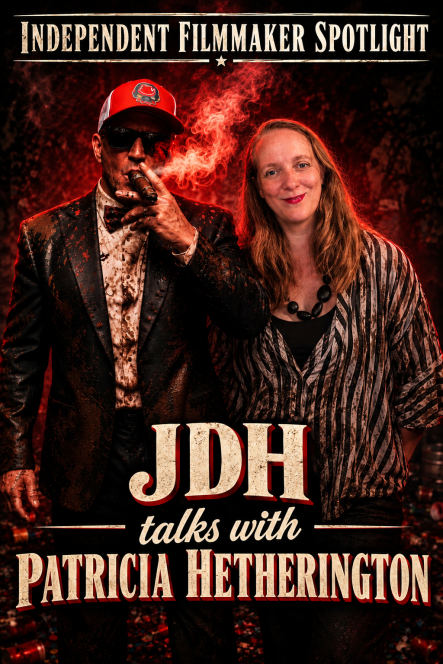
Apostoly Peter on small budgets, experimental horror, and the practical way he pitches grants and finishes projects
“I was run over by a car, so I stopped working — I got deaf in one ear, I couldn’t wear a walkie, and that changed everything.”
That line lands halfway through a conversation that never asks for sympathy and gives you instead an inventory of how a working indie filmmaker survives: grit, grant applications, guerrilla shoots, and a steady output of curious, often-horror work. Apostoly has built a career by doing the thing itself — Super 8 experiments, 16mm desert shoots, animated shorts — while juggling caregiving, disability benefits, and the odd festival win.
How he funds a film without corporate deals
Apostoly isn’t hiding corporate talk; he simply says it isn’t his language. Still, he has navigated institutional funding enough to list concrete wins: a Film Corps grant out of New York, a DC Arts Council award, and a ten-thousand-dollar grant from the Quebec Arts Council. He explains that winning looks like a neat, paper-bound plan — no mysticism, just a packet with a timeline, storyboard, shot list, and realistic numbers.
- Pitch yourself and the movie: explain who will do what and why you can do it
- Include a timeline, storyboards, and a shot list
- Make the budget add up — the reviewers are quick to say no if the numbers don’t make sense
“If you put it in the pamphlet that they ask for, and it makes sense, you stand a chance,” he says. He also admits grants are stingy and gatekeepers are trained to reject first; that’s part of the rhythm. The takeaway: treat grant-writing like pre-production — detailed, disciplined, and executable.
Making experiments, surviving on small crews
Apostoly’s films run from horror-leaning experiments (Going Ape 1 and 2) to an adult cartoon and a rom-com tinged with horror (The Things I Should Have Said). Production in Canada pushed him toward being a jack-of-all-trades: “When I make a film, it’s me and a sound guy and maybe a couple of PAs, if I’m lucky. Everybody’s donating their time.” That scarcity forced him to write smaller and smarter.
He also told a practical story about film stock on location: shooting 16mm in the desert means guarding the negative’s temperature or losing thousands of dollars worth of work. That kind of risk is why Apostoly often chooses formats and scripts he can afford to finish and distribute. He keeps many of his films available — some on Film Hub and Dark Side Releasing — and treats distribution as a continuation of production, not an afterthought.
“You pitch how you’re gonna do it, and you have to make a timeline. Basically how you’re gonna do the whole thing, storyboard, shot list.” — Apostoly Peter
Writing and the one habit that changed his drafts
Apostoly admits he used to write the way many of us do: start with a feeling, follow the characters, see where it goes. A single piece of advice from a friend changed that: write the beginning, middle, and end first. He credits Craig Wenman for drilling that into him — the structure doesn’t kill experimentation; it gives the smaller-scale production a shape that can be produced reliably.
This is practical for two reasons: it stops scripts from ballooning into unshootable vagabond pieces (20 locations, 40 cast members), and it makes your grant and budget documents believable. Apostoly pairs that discipline with creative risk: experimental forms, horror elements, and an eye for odd, ironic twists.
Where he sees the industry and what that means for you
Apostoly thinks the business is decentralizing. He points to platforms like Film Hub and the increasing number of streaming outlets as new, practical routes for indie filmmakers. He hears the same thing many of us do: crews are smaller, incentives move work to other states (or countries), and the old gatekeepers are loosening grip. He expects prestige rituals to migrate too — he even mentions award shows changing platforms in a few years — which is less a prophecy than an observation about momentum.
This shift carries trade-offs: easier access to distribution and more demand for niche work, but smaller crews, compressed pay, and tougher day rates. Apostoly’s answer is the same one he uses in practice — keep making films you can finish, win small grants, and make the paperwork match the imagination.
The clean, unsentimental lesson
Three years from now, Apostoly wants to make one big-budget film that pays off the work he’s still paying for in installments. It’s both a modest wish and a practical plan: make consistent, visible work, keep applying for the modest pots of money that exist, and write scripts you can actually shoot.
If you want the full texture — the road trips, the Venice Beach 16mm shoots, the festival stories and the names he drops — the episode is worth a listen. Apostoly’s approach is low-ego, high-output: it reads like a production manual written by someone who’s still too busy making things to polish the myth around them.