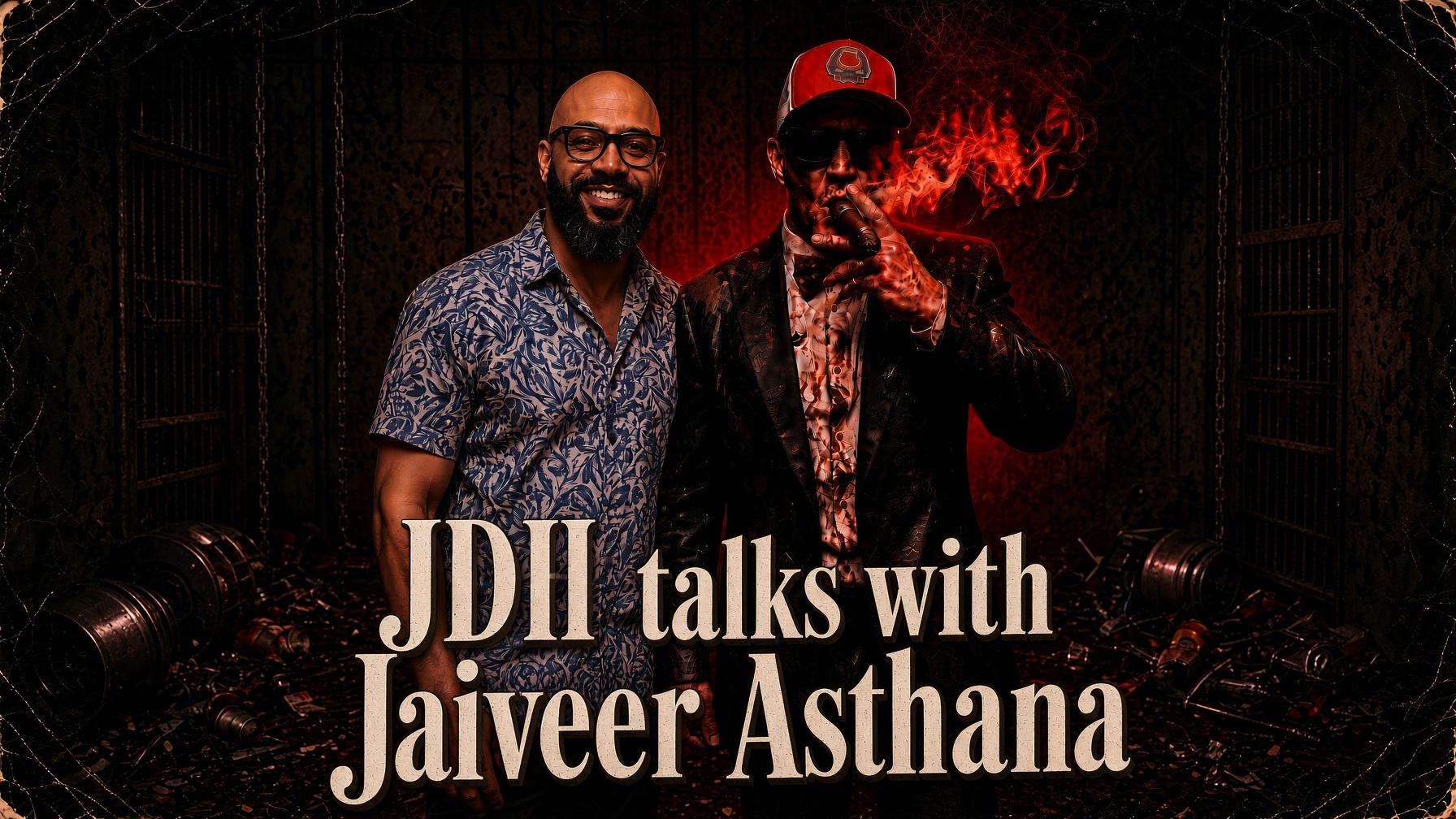
Jaiveer Asthana’s guerrilla shoots, £4,000 park permits turned into £66 insurance, and why verticals (and brands) pay the bills now.
“I don’t ever want to lament something that I can do because no one said yes you should do it.” — Jay
That line lands early and holds the episode. Jay walked into filmmaking from Brazilian Jiu Jitsu, grabbed a Panasonic G7, and taught himself the job by making thirteen, fourteen short films with friends — martial artists, animators, actors — until he could make a feature. The result: three features so far, a fourth coming, and a handful of hard lessons that anyone trying to make something on a shoestring should hear.
Start small, finish, and show it
Jay repeats the same mantra: tell a concise story, keep locations and cast tight, finish the project, and then let people watch it. His path was iterative — dozens of shorts to learn kit and workflow, then features produced with tiny crews (often just two or three people). He screens in a small cinema for two showings, then uploads to YouTube. That’s phase one: proof of craft and proof of audience.
Why that matters: distributors and funders want metrics or prior success. Jay stopped waiting for someone else to greenlight him and instead built an audience on YouTube, which now lets him offer view numbers when he approaches brands or festivals.
The single biggest technical lesson: audio
Jay’s blunt takeaway: audio will sink you faster than anything else. He learned this the hard way using a cheap shotgun mic (about a 30‑pound model) and scratchy lapels. On the feature that played in cinemas, a friend saved the release by insisting they fix the sound before projection.
Practical bit: record room tone, insist on clean mics even when you’re the boom operator and camera person. Jay now budgets for better audio as a priority — an easy upgrade that changes perception more than chasing “more pixels.”
Guerrilla filmmaking: permits, police, and improvisation
There are stories here that only come from doing it: filming a stabbing scene in a tunnel while a policeman walked over; lying and saying “we’re making a TikTok” to keep a shoot alive; being told a park permit would cost £4,000 a day, then finding a route to film legally for £66 by working with a studio that advises on permits and insurance and limiting crew size.
The arithmetic is useful: if you can reduce locations and crew and pay for the minimal insurance, you can legally shoot in more places than you think. But Jay also warns that sometimes you just have to take the risk and get the shot — until you run into an officer who won’t smile.
Where the money comes from now: verticals, social, and brands
Jay is pivoting to verticals and short-form social content as a business model. He’s producing vertical pieces that get tens of thousands of views — examples he cites: one video hit ~91k, others 20k and 10k — and uses those numbers to sell sponsorships to smaller brands, then parlay that into pitches for bigger partners.
His logic: platforms require high thresholds to pay directly, but brands want reach. If a vertical or a YouTube short can deliver 10–15k views reliably, product placement or sponsorship becomes a reliable revenue stream to fund the next project.
On equipment, craft and the middle ground
Jay’s practical view on gear is worth repeating: a camera made in the last ten years is probably “good enough.” Composition, lighting, angle and performance beat obsessing over “6K” or expensive sensors. He upgraded to a RED and better lenses only after he knew what shots he wanted and how audio should be handled.
He wants to keep improving incrementally: fewer locations, smaller casts, crisp audio, and better room‑tone practice. That’s the path from “we’re learning” to “we made something people want to watch.”
“We should all be making. If you want to write a book, make music, make a movie — this is probably the easiest time to do it.” — Jay
Cultural riffs that matter to creatives
The conversation moves through why big franchises feel hollow now, how comedy has narrowed under new rules, and why audiences still flock to underdogs. Jay argues the industry’s gatekeepers have lost the middle ground: everything tilts either to mega‑budget franchise work or disposable slop. That gap is where indie filmmakers and vertical creators can live and win.
What Jay wants in three to five years
A small London production house that helps new filmmakers make their first projects end‑to‑end: storyboards, production, cinema runs. He wants to give the “yes” his stop‑motion friend needed. He’s already building the tools — crew, red camera, festival knowledge, and a social strategy that attracts sponsors.
If you’ve ever sat on an idea waiting for permission, Jay’s approach is a useful corrective: start small, treat the first films like training, prioritize audio and finishing, and use social as a currency to attract brands or festival attention.
If you want the full conversation — the permit story in detail, the tunnel scene, and the bits where Jay picks apart modern comedy — listen to the episode. It’s a compact masterclass in doing more with less.