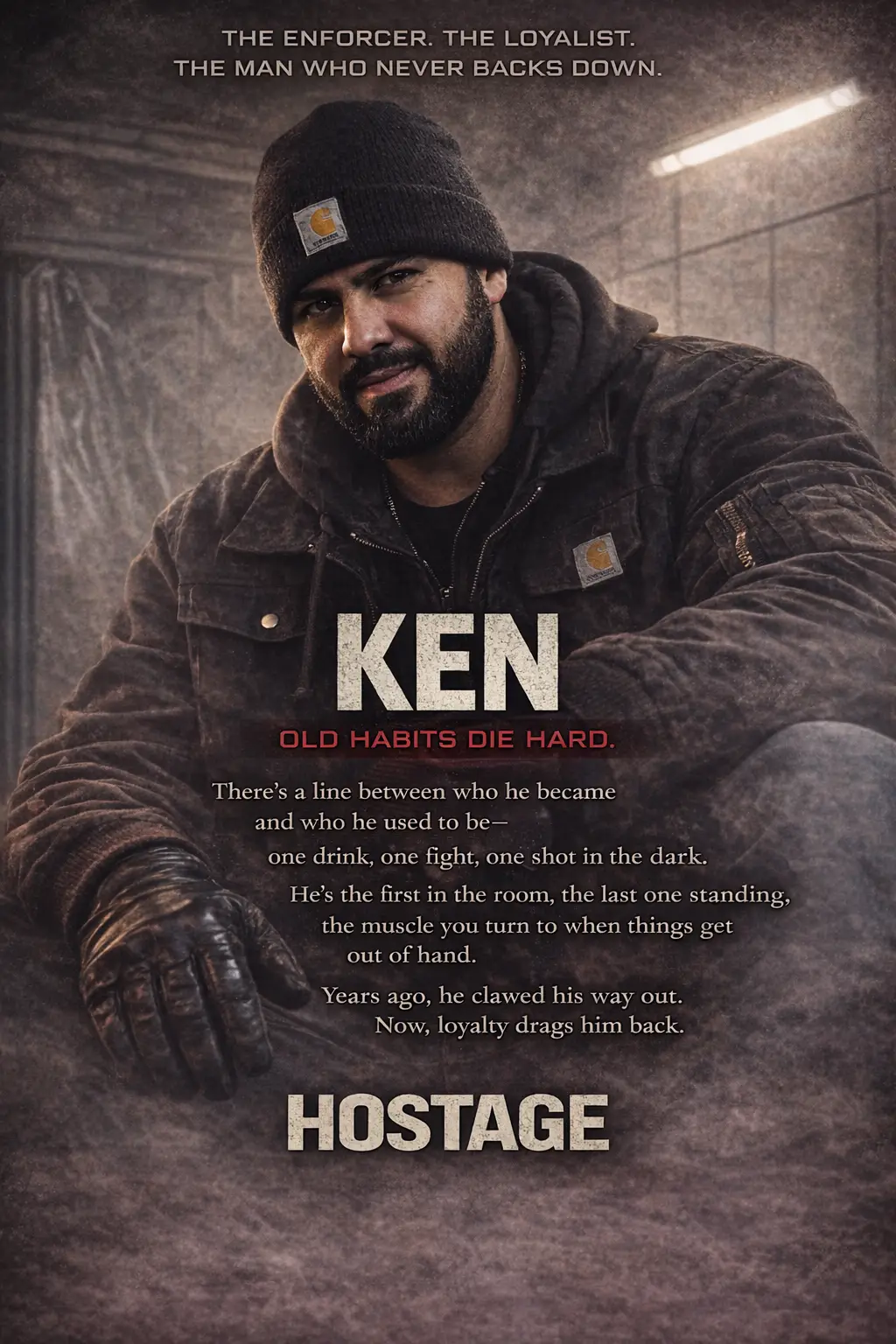
Ken is the kind of presence you feel before you fully register it. The energy of a room shifts when he walks in—not just because he can be loud, but because there’s an undeniable gravity to him. Charismatic without trying and impossible to ignore, Ken doesn’t chase attention—attention finds him.
From the moment he met Roy and Bob in third grade, the three formed an unbreakable bond. But within that trio, Ken was always the spark. Not the strategist like Roy or the stabilizer like Bob—Ken was the ignition. The one who turned hesitation into action.
The Instinct That Defined Him
Ken’s identity was built on instinct. Where others paused, he moved. Where others calculated risk, he absorbed it. As a kid, that made him fearless in a way that felt almost mythic—the one who would throw the first punch, take the hit, and come back harder.
Over time, that fearlessness evolved into something more dangerous. It wasn’t that Ken controlled fear—it’s that he stopped feeling it altogether.
In the small world he grew up in, that made him a natural leader. People followed him not because he demanded it, but because he seemed unbreakable.
Becoming the Enforcer
As life escalated and consequences became real, Ken stepped into the role that fit him too well: the enforcer.
When something needed to be handled quickly and without hesitation, Ken was the answer.
Violence wasn’t just a tool—it was a language. One he spoke fluently. It simplified everything. Right and wrong became secondary to action. For years, he lived at full speed—fighting, drinking, and refusing to slow down long enough to question where it was all heading.
Because slowing down meant facing himself.
The Breaking Point and Sobriety
Sobriety didn’t come as clarity—it came as collapse.
After too many blurred nights and irreversible choices, Ken reached a point where he could no longer outrun the consequences. Walking away wasn’t just about quitting alcohol—it was about dismantling who he had become.
And for a time, he succeeded.
He became quieter. More controlled. A version of himself that felt almost unrecognizable. The intensity was still there, but buried—contained beneath discipline.
But that version of Ken was fragile.
It wasn’t built on transformation. It was built on suppression.
The Return of Instinct
The crisis at the center of HOSTAGE pulls Ken back into the life he tried to leave behind. The same pressures. The same people. The same rules.
And under that weight, the cracks begin to show.
Because instincts like his don’t disappear—they wait.
Now they’re returning—sharper, more calculated, and more dangerous than before. The difference is that Ken understands them now. He knows the cost of what he’s capable of.
And that awareness doesn’t stop him—it complicates him.
Loyalty as Strength—and Weakness
At his core, Ken is driven by loyalty. Roy and Bob aren’t just friends—they are the only constants he’s ever trusted.
That bond grounds him. But it also binds him to a past he’s trying to escape.
For Ken, loyalty isn’t just a virtue—it’s a force. One that can protect or destroy, depending on how far he’s willing to go.
A Man Divided
Ken can still find humor in chaos. He can still smile in the worst moments. But those moments feel thinner now—like a surface stretched over something volatile.
Because Ken knows how these stories end.
He’s lived them. He’s caused them.
And now, he exists in the tension between two versions of himself:
- The man he fought to become
- The man he used to be
That is where Ken truly lives—not in his past, and not fully in his present, but in the space between them.
Final Thoughts on Ken in HOSTAGE
Ken is not just a character defined by violence or redemption—he is defined by the conflict between the two.
As the pressure builds, one question becomes unavoidable:
Not whether Ken will break—
—but which version of him will be left standing when he does.