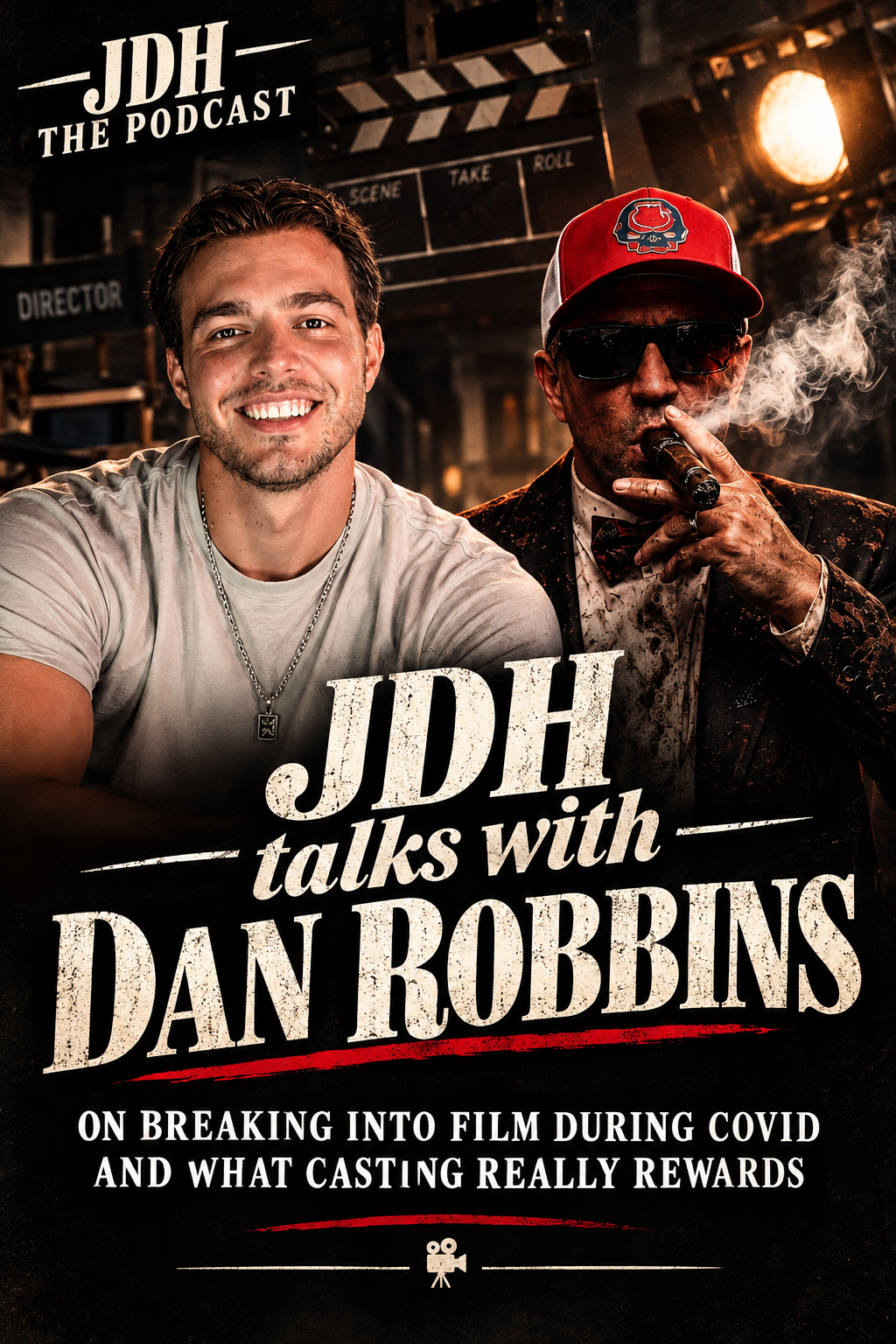
How Dan Robins turned a £50k microbudget into a distributed film, built an audience, and learned to treat short films as proof of concept.
“I can drag it through — I can pull this production across the line myself if I have to.” — Dan Robins
Dan starts sentences like he starts careers: by saying yes. He moved from acting into running sets overnight, accepted a first AD call at midnight, then leaned into producing, directing and a self-distribution model that treats a film as a brand.
How he bridged actor instincts to first AD muscle
Dan told the story of showing up on a shoot as a runner, being asked if he could cover first AD duties the next day, and saying yes. His acting background meant he’d heard ADs’ rhythms enough to “pass as an AD,” but the job then became a steep learning curve in scheduling, fire‑fighting and being the person the crew trusts.
He framed the role this way: if you have to raise your voice, you probably failed at leadership. That approach — calm, anticipatory problem solving — is how he keeps sets working and why production assistants and runners matter so much: their practical common sense has saved him repeatedly.
Making Burned Edges on less than $50k and why that still works
The feature Burned Edges was made for under $50,000, Dan says, though they negotiated deals and swapped promotion for services that would normally have pushed the cost closer to $150k. Two concrete tactics he used:
- negotiate location and in-kind deals (one location provided food in exchange for promo);
- promise promotional value to partners in return for discounts on gear and services.
That hustling kept paychecks in people’s pockets while delivering a product that, in Dan’s words, “should have been $150k but we made it for $50k.” He’s realistic: microbudget work carries visible weaknesses. But the short‑term tradeoff is credibility — once you prove you can finish a film and shepherd a team, you can produce again.
Distribution as ownership and audience activation
Instead of handing Burned Edges to a middleman and hoping, Dan’s team chose a self‑distribution route. They paid an aggregator for a flat‑fee deal (to avoid ongoing percentage cuts) and then leaned on their social reach — Dan estimates an audience of three to four million people who could be activated.
Their rollout strategy is deliberately multi‑channel: a special access screening funded by a partner, direct sales and streaming on platforms like Amazon and Apple, and a website that turns the film into a micro‑brand (merch, DVDs, even a fictional pizza shop from the movie). Dan describes it as making the film “part of the real world,” the way shows turn props and locations into products fans want to buy.
On numbers, Dan is frank: streaming math rarely matches eyeballs. Prime and similar platforms take big cuts, and a million streams doesn’t always translate to a fortune. That’s why owning the distribution and selling direct can be decisive for a microbudget team.
Short films, verticals and new monetization — where he places proof of concept
Dan uses short films as proof of concept: a compact way to show tone, world and potential for expansion. He made a short for roughly £3k that won festival awards and opened conversations about features — but he also admits that even award laurels rarely guarantee large financing without a bigger track record.
On verticals (TikTok/short episodic formats) he has hands‑on experience. The format demands addictive, cliffhanger writing: Dan mentioned the sweet spot is roughly 1:45–2:15 per episode and that creators often produce 30–60 slices to form a full story. Monetization methods he noted include membership models, per‑episode payments, ad sponsorships and in‑app currency systems. Vertical projects can be quick, cheap proof points — but they require a different writing and performance language than traditional film.
What comes next and the year Dan wants
Concrete aims: Dan just booked his first directing gig and wants his ideal annual slate within three to five years — directing two films, producing one, and acting in one. That rhythm, he says, lets him “do less with more”: scale up the impact of each project while keeping people employed.
He’s also taken on projects to resist an industry shift toward replacing actors with AI, saying bluntly that he’ll push to keep actors working. The mix of directing, producing, first AD work and acting is intentional: it’s how he creates opportunities instead of waiting for them.
Burned Edges launches October 2. If the film succeeds, Dan expects the team’s labor on distribution and social activation to be part of that success — not an afterthought.
If you want the full, funny, granular conversation about how he negotiated location deals, structured the aggregator contract, and cut a feature for fifty thousand, the episode is worth the listen. Or keep an eye out October 2 for Burned Edges — it’s the case study Dan’s been building toward.
PODCAST LINK: https://www.youtube.com/watch?v=usykXwcrubQ
JDH talks with Dan Robins – Independent Filmmakers Spotlight – What It Really Takes to Make It