The Boss – Character Breakdown in HOSTAGE
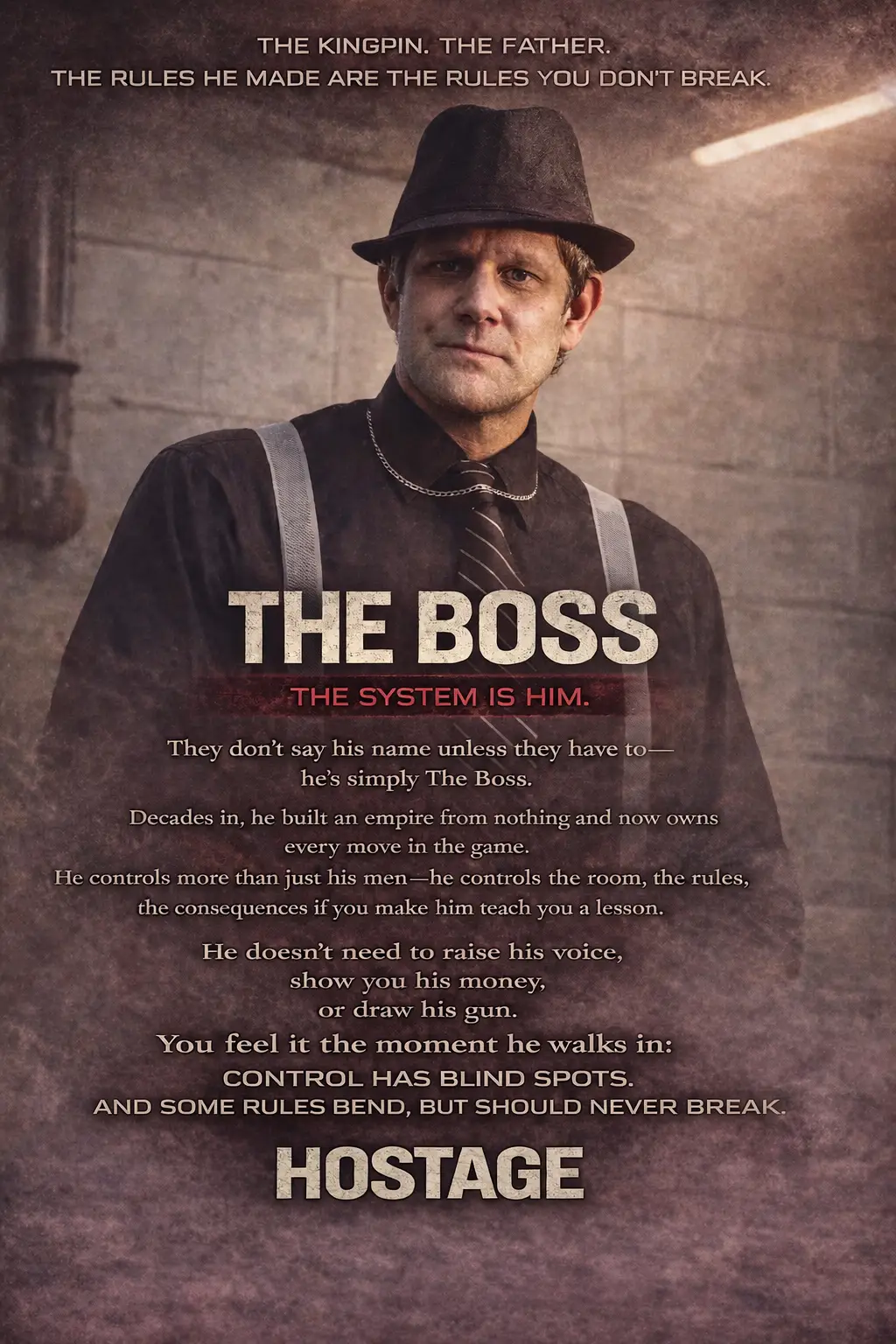
They don’t say his name unless they have to.
To most, he’s simply The Boss—a man whose authority doesn’t rely on volume, threats, or spectacle. His presence alone is enough. It carries a weight built over decades, reinforced by decisions that shaped not just an organization, but the people inside it.
His power isn’t loud.
It’s absolute.
The Architect of Control
The Boss didn’t inherit power—he built it.
Piece by piece, mistake by mistake, he constructed a system that operates with precision and discipline. Every rule, every hierarchy, every unspoken understanding traces back to him. It’s a structure designed to eliminate uncertainty, to anticipate risk before it materializes.
Where others lead through fear, The Boss leads through certainty.
He doesn’t raise his voice because he never has to. His authority isn’t questioned—not because of what he might do, but because of what he’s already done. The history speaks for him.
Control, for The Boss, isn’t just a method.
It’s identity.
A Lifetime of Calculation
What makes The Boss formidable isn’t just power—it’s experience.
He has seen every form of betrayal. Every variation of desperation. Every way a situation can spiral out of control. And he’s survived all of it by staying ahead—by calculating outcomes before others even recognize the variables.
Nothing is left to chance.
Every move is measured. Every risk weighed. Every consequence anticipated.
Or at least, that’s the illusion.
Because even the most controlled systems have blind spots.
The One Exception: Ruby-Ann
For all his discipline, there is one place where The Boss allows himself something dangerous: emotion.
His daughter, Ruby-Ann.
She exists outside the world he built—a boundary he has fought to maintain at all costs. With her, he permits a version of himself that no one else sees. Softer. Protective. Human.
She represents something separate from the system. Something untouched.
Or at least, that’s what he tells himself.
Because the line between those two worlds is far thinner than he wants to believe.
When Control Becomes Illusion
That illusion begins to fracture the moment Adrian enters the picture.
What should have been a controlled response—a simple warning, a contained message—quickly escalates beyond expectation. The Boss reacts the way he always has: decisively, efficiently, without hesitation.
He pulls Adrian into the situation, assuming it can be managed like everything else.
But this isn’t business.
It’s personal.
And personal decisions don’t follow the same rules.
Inside the System He Created
For the first time in years, The Boss isn’t observing from a distance—he’s inside the chaos.
Surrounded by Roy, Bob, and Ken—men he didn’t just employ, but shaped—he’s forced to navigate a situation that no longer adheres to his structure. These aren’t just subordinates; they are extensions of his past, reflections of the system he built and the choices that defined it.
His relationship with Roy, in particular, blurs the line between professional loyalty and something closer to family. That history complicates everything. It introduces variables that can’t be calculated the same way as business decisions.
And those variables begin to shift the balance.
Awareness Without Escape
What separates The Boss from others in his position is his awareness.
He can see when control is slipping. He can recognize when a situation is no longer contained. He understands, perhaps sooner than anyone else, that this has gone further than intended.
And he adapts.
He pivots. Reassesses. Adjusts.
But awareness doesn’t equal control.
Because The Boss isn’t just managing a problem—
He is the system that created it.
The Cost of Power
Every rule, every hierarchy, every man in that room exists because of him.
And now, those same structures are being tested under pressure he didn’t anticipate. When personal emotion collides with calculated order, the result is something unpredictable—something even he can’t fully control.
For decades, The Boss has been the architect of order in a world defined by chaos.
But systems, no matter how well-designed, are only as strong as their weakest variable.
And this time, that variable is personal.
Final Thoughts on The Boss in HOSTAGE
The Boss represents power at its most refined—quiet, controlled, and deeply rooted in experience.
But HOSTAGE reveals the limits of that power.
Because control, no matter how absolute it seems, is never complete.
Not when emotion enters the equation.
Not when the past resurfaces.
Not when the system begins to turn inward on itself.
The truth The Boss must confront is one he has spent a lifetime avoiding:
Some things can’t be controlled.
Some consequences can’t be contained.
And this time, the cost isn’t abstract—
It’s personal.